
For roughly 800 years, the accounting profession barely changed.
We went from the quill pen to the ballpoint, the abacus to the pocket calculator, but fundamentally what accountants did stayed the same. Double-entry bookkeeping was in use in Florence by 1211, and Luca Pacioli codified it in 1494. It shifted a little with accounting software in the late 1970s, but nothing fundamental changed until now.
AI has put the profession on a path of seismic change. If you stridently disagree with that, in my view, you just don’t “get it.” The emergence of AI has split accountancy into two camps: those who recognise the power of AI and the improvements it can make to their businesses, and those who believe it’s overhyped and the profession will carry on largely as is. That’s the real distinction, between those who get it and those who don’t.
I’ve been a Chartered Accountant for over 30 years, and I’m also a founder of FD Intelligence, an AI development business in the UK tax and accounting space. My own view on AI is, honestly, complicated. The tools we’ve built are phenomenal, they make our clients dramatically more efficient, and one product can identify revenue opportunities clients would never have found on their own. Having seen what’s possible, I believe AI will eventually do most, if not all, of what an accountant does. I’m not alone in that view: Microsoft AI’s own chief, Mustafa Suleyman, told the Financial Times this year that most white-collar tasks, he named accountants specifically, alongside lawyers, would be “fully automated by an AI” within 12 to 18 months. That’s not a rival tech bro talking his book; that’s the company that makes Excel.
I don’t think AI is straightforwardly good for society, for what it’s worth. Like nuclear technology, its power cuts both ways, and I suspect we’ll spend decades managing the fallout. But that’s not an argument for pretending it isn’t happening. It’s here, and it’s incumbent on anyone running an accountancy practice to recognise its power and embrace it. If you still think this is a passing fad, I had a client back in 2001 who owned a chain of photo-processing shops. I asked what he made of digital cameras. “A passing fad,” he told me. That business no longer exists.
For the accountancy profession, the iceberg has hoved into view. The smart leaders will adapt and prosper. The ones who don’t recognise the threat and the opportunity may go the way of my former client.
As a final thought, I was struck by an ICAS headline from March this year: “AI can’t replace human judgement in accounting.” The finding underneath it was that 72% of accounting professionals feel AI can’t replace their judgement. To me, that’s not reassurance, it’s a raft of accountants not getting it.
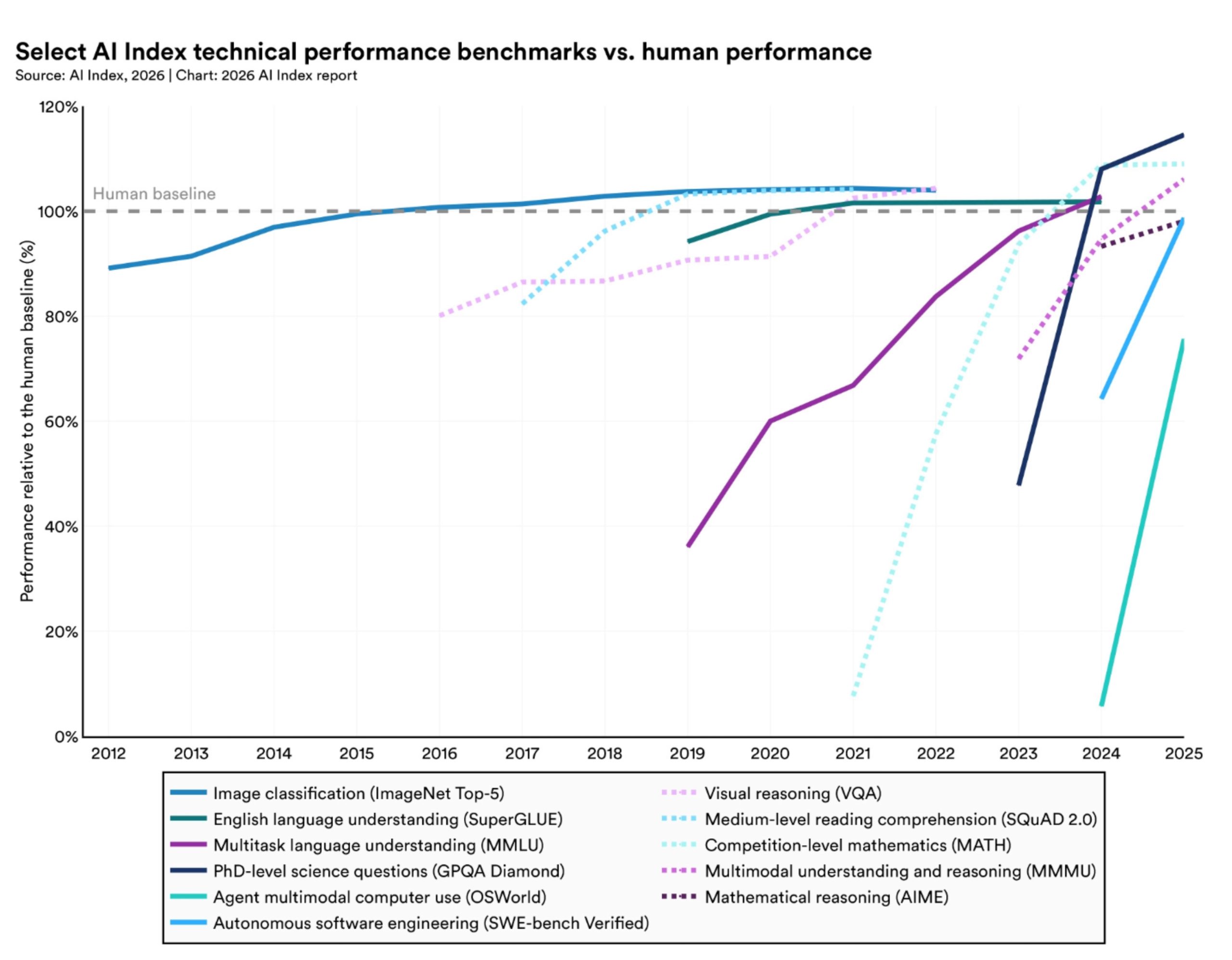
If you doubt what AI can do, look at the chart below. It tracks AI performance against human ability across a range of benchmarks, including MMLU and GPQA Diamond, both close proxies for the kind of exam-based, judgement-driven knowledge that accountancy training tests. The point isn’t that AI has, in large part, already reached human capability. It’s that these lines keep climbing. Human performance doesn’t.